
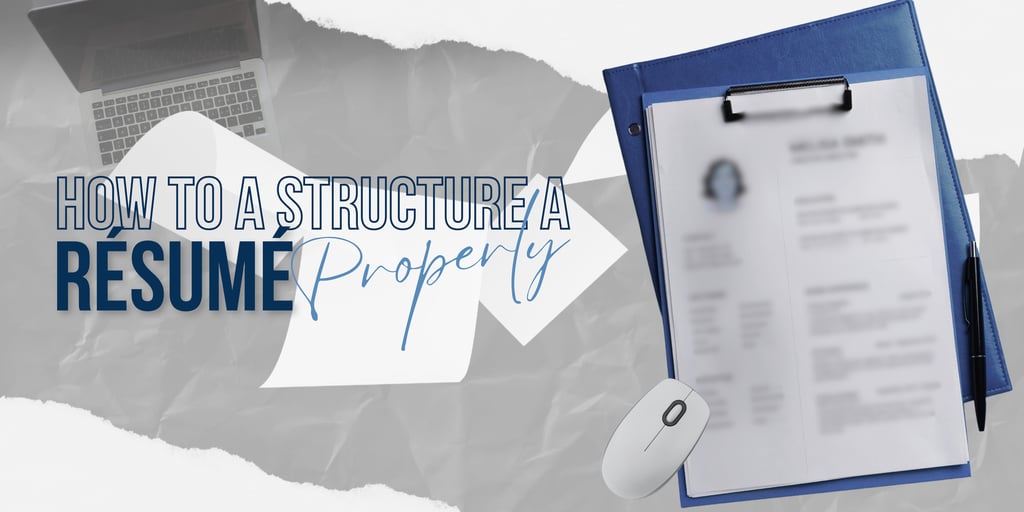
How to Structure a Résumé Properly?
Say goodbye to the generic CV.
Before we begin
Your résumé is often the first impression you make—and in many cases, the only one. In a competitive job market, knowing how to structure it properly can be the difference between being considered or overlooked.
This guide is not about filling space with buzzwords or clichés, but about learning how to communicate who you are through facts, experience, and clarity. A well-structured résumé doesn’t just list information; it tells a story that makes sense to recruiters and highlights your real value.
Let’s break down how to do it right.
The Introduction
This section should be written in the first person, but without self-labeling or subjective descriptions. Phrases like “I’m very responsible,” “I work well under pressure,” “I’m a team player”—or any other cliché—add little to nothing for a human resources department.
Before writing anything like that, consider this: everyone says the same thing.
Any quality you claim should be demonstrated through actions, such as your experience, education, and achievements. If you are “responsible,” make it evident through facts.
Focus on concrete information, such as:
Years of experience: how long you’ve been working or studying in your field (clarify whether it’s professional or academic experience).
Companies: the organizations you’ve worked for.
Functional areas: the fields you’ve worked in. In graphic design, for example, this could include illustration, web design, photography, advertising design, branding, etc.
Key strengths: your main professional skills.
Geographical reach: if you’ve worked in different countries or regions.
What you can do: highlight abilities relevant to the role you’re seeking.
Education: your highest completed degree.
Languages: the languages you speak and your proficiency level in each.
Remember: keep this section concise, but clear and professional.
Two examples of well-written introductions
Case 1: A professional with work experience
Graphic designer with three years of professional experience, working with companies such as Alimentos Polar, Distribuidora Marcella, and Cosmic Boutique. My work focuses primarily on photography and advertising design. My strongest skills include layout design, photo editing, and social media design. I have worked on projects for clients in Venezuela, Ecuador, and the United States. I am capable of creating consistent advertising visuals aligned with brand identity. I hold a Bachelor’s degree in Graphic Design and have a certified B2 level of English (TOEFL).
Case 2: A professional without formal work experience
Graphic design student with two and a half years of professional training. I completed internships and community service projects for the Caracas City Hall. My main focus is advertising and editorial illustration. My strongest skills include character design and scene illustration. I have developed several creative projects in Caracas and am capable of illustrating full literary narratives. I am currently completing a Higher University Technician degree in Graphic Design and hold a B1 level of English certified by EFSET.
Notes on the introduction
This section is important because when recruiters receive a large volume of résumés, some may choose to read only the introductions first as a quick summary of each profile. Recruiters appreciate a clear introduction that works as an overview.
The introduction must also be consistent with the rest of the CV. For example, if you mention professional experience as a photographer, your work experience section should clearly show where and how you worked in that role.
To improve readability, you may bold key information.
Professional Experience: give depth to your achievements
When describing work experience, don’t just list job titles. Explain what you did and what you achieved. Follow this structure:
Company name
Position / role held
(Start month and year – end month and year)
If you’re still in the role, list the start date followed by “Present”.
Then include a bullet list of responsibilities and achievements:
Start each point with an action verb (e.g., Designed, Managed, Implemented).
Include measurable results whenever possible:
“Reduced costs by 15%,” “Increased team productivity by 20%.”Explain how you achieved those results and which tools or methods you used.
Example
Polar Enterprise
Technology Project Coordinator (01/2020 – 12/2023)
Designed and led the implementation of a CRM system that increased sales by 25% within the first year.
Managed a team of 10 people, ensuring project completion within established deadlines.
Reduced operational costs by $50,000 annually by optimizing internal processes.
Notes on work experience
Whenever you’ve held a role, there is always at least one achievement—or at minimum, a clear description of what you did. This is what truly shows HR what you’re capable of.
List experience from most recent to oldest, and use the same structure throughout.
Use the same format for internships or community service, clearly labeling them as such.
Education: highlight your academic background
This section should clearly present your academic achievements:
Degree obtained (Start year – End year)
If still in progress, specify your current semester.University / School / Institution
Include:
Academic honors, if applicable.
Relevant projects, describing context, actions, and results.
Example
Bachelor’s Degree in Systems Engineering (2015 – 2019)
National University
Featured project: “Design of a Business Management System”, reducing processing time by 30%.
Graduated with honors (GPA above 9.5/10).
Courses
List courses simply: course name, institution, and year. Certified online courses are welcome.
Data Analysis Certification, Coursera, 2021
Leadership for Technology Teams, Stanford University, 2022
And others.
Additional Information or Languages
This section can set you apart. Include extracurricular achievements and realistic language proficiency levels.
Languages
Use official proficiency scales. For English:
A1–A2: Basic
B1–B2: Intermediate
C1–C2: Advanced
If you’ve taken official exams, mention them. The TOEFL is widely recognized by companies and universities worldwide. A strong score demonstrates effective communication skills in academic and professional settings. While it requires an investment, it can open many doors.
If you’re looking for a free alternative to assess your level, EFSET is a good option. It provides a clear evaluation and can be included as a reference.
You can take the test at: https://www.efset.org/
Still, your long-term goal should be taking the TOEFL, as it’s more widely accepted for résumés, visas, scholarships, and international applications.
Extracurricular activities and achievements
Include long-term activities that reflect commitment and additional skills, such as:
Environmental volunteering (2018 – Present)
Hackathon participation, second place winner in 2022
Publication of technical articles on specialized blogs
Elite athlete at Caracas Football Club, competing in tournaments in Peru, Ecuador, and Venezuela
Featured ballet dancer at Teatro Teresa Carreño, starring in The Nutcracker
Even if they’re not directly related to your profession, these achievements speak volumes about you as a person.
Software
If you use digital tools, list them clearly:
Adobe Illustrator
Adobe Photoshop
Adobe After Effects
And others.
A final surprise
A common mistake is using the same résumé for every company. That’s not ideal. Each résumé should be tailored to the role you’re applying for. This means researching the company, highlighting relevant skills and achievements, and adjusting language and keywords to match what they’re looking for.
Yes—it takes extra effort. But it significantly increases your chances of being considered.
A generic résumé may go unnoticed, while a customized one shows interest, preparation, and professionalism. Your effort is worth it.
Ready for your next professional step?
I recommend reading my articles How to Create a Professional Graphic Design Portfolio and How to Get Graphic Design Clients.
Follow me on Social Media
Zephora Graphic Design © 2025. All rights reserved.